
Older homes, snowy winters and the hills of north-central Ohio
Spray Foam Insulation in Mansfield, OH
Air sealing and insulation for Richland County homes, barns and shops, with every price in writing.
- Free on-site estimates across Richland County
- Written quote listing foam type, thickness and R-value for each space
- Roof leaks, damp sills and old wiring flagged before anything is covered
Insulation Built for a Snowbelt-Edge Winter
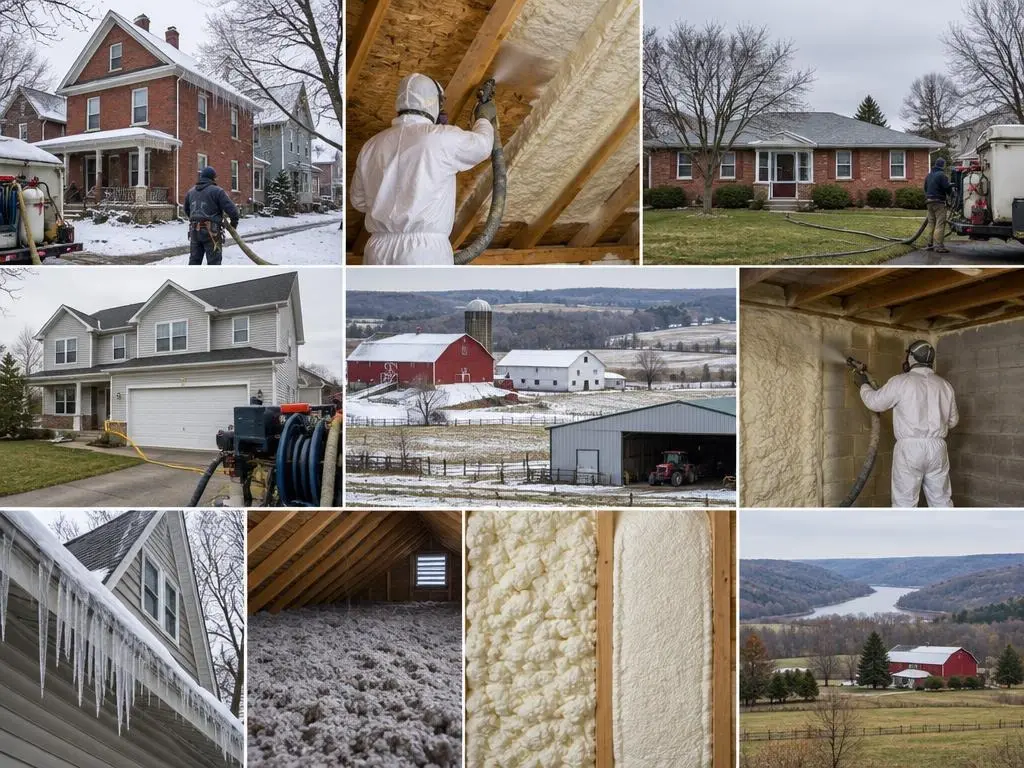
Spray foam insulation in Mansfield earns its keep in winter. Wikipedia's climate summary for the city lists an average January temperature of 26.5F, about five nights a year at or below zero, and 49.2 inches of snow a season, with Lake Erie only 38 miles to the north. Mansfield also sits higher than most Ohio cities, about 1,240 feet at Central Park, in the western foothills of the Allegheny Plateau. A house that leaks warm air through the attic, the rim joist and the basement walls pays for it every heating season. As local spray foam insulation contractors, we find those leaks, seal them and insulate the spaces that need it, using open-cell or closed-cell foam where it pays and blown-in insulation where that does the same job for less.
What Ohio's code asks for in Richland County
Ohio's residential energy rules (Ohio Administrative Code 4101:8-11-01, Table 1101.7) place every county in this part of the state, including Richland, Ashland, Crawford, Knox and Huron, in Climate Zone 5A. The Ohio table lists R-49 for ceilings, R-20 or R-13 plus R-5 continuous for wood-frame walls, R-30 for floors over unheated space, and R-10 continuous or R-13 cavity for basement and crawl space walls. For an existing house, ENERGY STAR's chart for Zone 5 recommends bringing an uninsulated attic to R-60, or adding about R-49 when 3 to 4 inches are already there. Those are the targets we size attic depth and foam thickness against.
Why Mansfield houses lose heat
The housing is old. American Community Survey figures on Point2Homes show 24.6% of Mansfield's homes were built in 1939 or earlier, another 9.7% in the 1940s and 17.4% in the 1950s; only about 1.3% date from 2010 to 2019. Houses from the city's industrial years, when Westinghouse, Tappan and Mansfield Tire employed thousands, were framed with open wall cavities, plaster walls and attics holding a few inches of loose fill at most. The 1950s and 1960s ranches that followed are tighter but still thin in the attic and bare at the rim joist.
Newer homes have their own weak spots. In Ontario, where about a quarter of the housing went up in the 1990s, the usual complaints are a cold room over the garage, knee walls in a bonus room and an attic hatch that leaks like a chimney.
Closed cell vs open cell
Both foams go on as a liquid and expand in place, so they insulate and stop air movement in one step. Closed-cell foam is dense and rigid, rated by HomeGuide at about R-5 to R-7 per inch; at normal thickness it slows water vapor and does not soak up water. Open-cell foam is soft and light, about R-3.5 to R-3.7 per inch, and it seals air and quiets sound well, but vapor passes through it.
In a Zone 5 climate, closed-cell is usually our pick for rim joists, basement walls, crawl space walls, pole barn walls and roof decks with no room for vent channels. Open-cell works for interior walls, sound control and some rooflines when the moisture plan is right. Across a wide, open attic floor, foam is rarely the cheapest answer: sealing the gaps with foam and caulk and then blowing in cellulose or fiberglass to depth usually costs less for the same R-value.
Ice dams and frosty attics
When warm air leaks into the attic, it melts the underside of the snow on the roof. The water runs down to the cold eave and freezes into an ice dam, which can back water under the shingles. The same leaking air carries moisture that frosts on roof nails and drips in the first thaw. Adding insulation alone does not stop this; sealing the top plates, plumbing and wiring holes, the chimney chase, recessed lights and the hatch is what does. That is the first thing we price on almost every Mansfield attic.
Questions to ask any insulation company
When you compare spray foam insulation companies or insulation contractors near you, a few questions sort out the careful ones. What will they seal before they insulate? Which foam do they plan for each space, how thick, and what R-value will it reach? How do they ventilate the house while spraying, and how long should you stay out (HomeGuide advises at least 24 hours)? What happens to old insulation that is wet or full of droppings? Will the quote break out the price for each area so you can compare bids line by line? We answer all of those on paper.
Spray foam insulation cost
HomeGuide's 2026 guide puts installed spray foam at $1.50 to $5.00 per square foot, with open-cell at $1.50 to $3.50 and closed-cell at $3.00 to $5.00. It lists foam on rim joists at $2,000 to $2,500, a whole house at $8,000 to $20,000, and a typical minimum charge of $1,000 to $2,000 or more. Fixr prices foam in the walls of an existing home at $3.15 to $7.50 per square foot. These national figures are useful for budgeting; your price depends on access, foam type, thickness and how much old material has to come out, and the figure on our written estimate is the one you pay.
When to schedule
The city's average last spring freeze falls around April 27 and the first fall freeze around October 19, per the Wikipedia climate summary. Basements and heated rooms can be sprayed any month. Pole barns, garages and crawl spaces are easier outside the coldest weeks, because foam needs the surface and the material inside a working temperature range, and attics are easier outside the hottest days of July.
Towns We Serve
We work in Mansfield and across Richland County: Ontario, Lexington, Bellville, Butler, Lucas, Shelby and Plymouth. We also serve Ashland and Loudonville in Ashland County, Galion, Crestline and Bucyrus in Crawford County, and Mount Vernon in Knox County. The housing changes from town to town. Mansfield, Ashland, Galion and Bucyrus are full of pre-war homes; Ontario grew up around a 1950s auto plant and kept building through the 1990s; the river villages along the Clear Fork and Black Fork of the Mohican have their own flood and damp-basement history. Each town page covers what is different there.
- Spray Foam Insulation in Mansfield, OH
- Spray Foam Insulation in Ontario, OH
- Spray Foam Insulation in Lexington, OH
- Spray Foam Insulation in Bellville, OH
- Spray Foam Insulation in Shelby, OH
- Spray Foam Insulation in Ashland, OH
- Spray Foam Insulation in Galion, OH
- Spray Foam Insulation in Crestline, OH
- Spray Foam Insulation in Bucyrus, OH
- Spray Foam Insulation in Loudonville, OH
- Spray Foam Insulation in Lucas, OH
- Spray Foam Insulation in Butler, OH
- Spray Foam Insulation in Mount Vernon, OH
- Spray Foam Insulation in Plymouth, OH
Common Questions
How much should I expect to pay for spray foam insulation in Mansfield?
HomeGuide's national range is $1.50 to $5.00 per square foot installed, with closed-cell at the top of that range, and many installers have a minimum of $1,000 to $2,000 or more. A rim joist job often lands around $2,000 to $2,500. We give a written price after seeing the house, and that price is what you pay.
What is the recommended R-value for home insulation in Ohio?
Ohio's residential code puts Richland County and its neighbors in Climate Zone 5, with R-49 for ceilings, R-20 (or R-13 plus R-5 continuous) for wood-frame walls and R-30 for floors over unheated space. For existing attics, ENERGY STAR suggests R-60 when there is nothing there now, or adding R-49 over 3 to 4 inches of old insulation.
Why is spray foam insulation sometimes called a red flag?
Problems come from poor installs, not the material itself: foam mixed or sprayed wrong can smell and pull away from framing, and foam sprayed over a leaking roof deck can hide rot for years. Some buyers and inspectors want to see the roof deck, so we check the roof first and document what we spray.
Why are people removing spray foam insulation?
Usually because it was installed badly, because it is hiding a leak or rot that has to be repaired, or because a remodel or sale requires access. Removal is slow hand work; HomeGuide puts it at about $1.00 to $2.50 per square foot. Getting the install right the first time is cheaper.
Is closed cell or open cell better for a Mansfield basement?
Closed-cell, in almost every case. Basement walls and rim joists sit against cold, sometimes damp masonry, and closed-cell foam resists moisture and gives more R-value per inch. Open-cell can absorb moisture there.
Do I need to leave the house while you spray?
Yes. HomeGuide advises staying out for at least 24 hours after spray foam is applied. We close off and ventilate the work area and tell you when it is safe to return. Blown-in insulation does not require that.
Why Homeowners Call Spray Foam Insulation Mansfield
We look before we price
Nobody gets a number over the phone. We measure the attic, check the basement and rim joist, and price what we actually saw.
Foam only where it pays
Closed-cell on rim joists, basement walls and barns; sealing plus blown-in on most open attic floors, because that usually reaches R-49 or more for less.
Problems flagged first
Roof leaks, wet sills, mold, vermiculite and old wiring get pointed out before we cover anything, so insulation never hides a problem.
Every line in writing
Material, thickness, R-value target and price for each space, so you can compare bids or do the work in stages.
What We Insulate
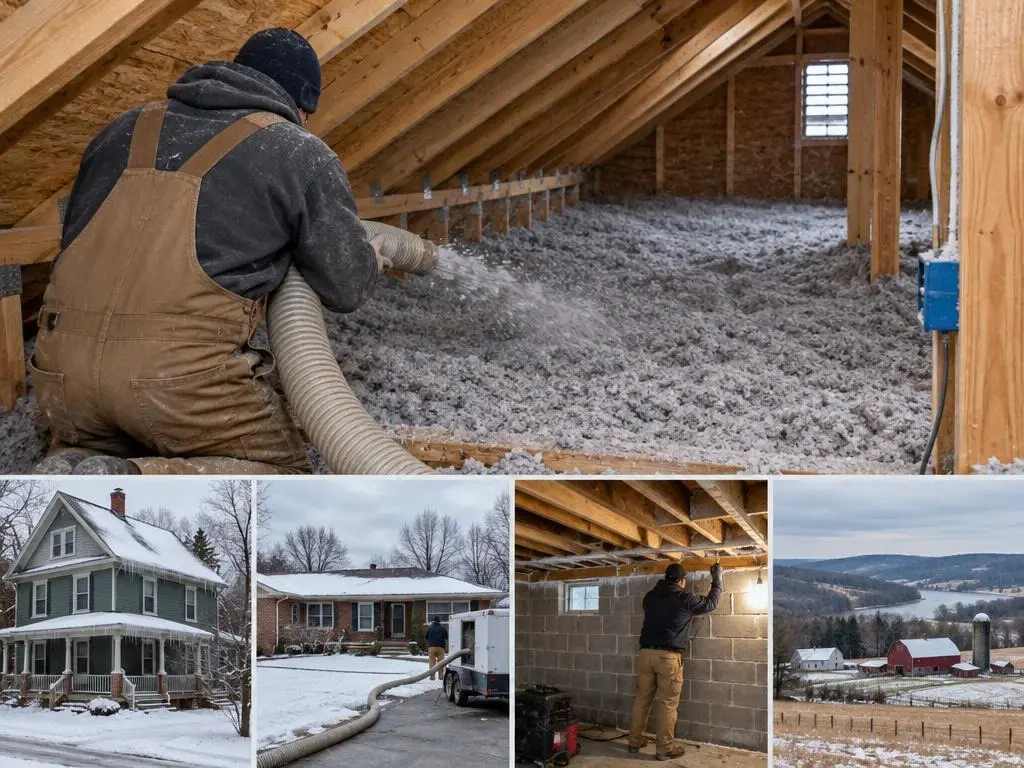
Six kinds of work, matched to the space: foam where it earns its price, blown-in where it is enough, and old insulation out when it has failed.
Spray Foam Insulation
Open-cell and closed-cell foam that insulates and air seals in one layer, where a Mansfield house needs it most.
Learn more →Attic Insulation & Air Sealing
Seal the leaks, then bring the attic to R-49 or more, the step that does the most for comfort and ice dams.
Learn more →Basement & Rim Joist Insulation
Closed-cell foam on rim joists and basement walls, the cold band at the bottom of most older Mansfield houses.
Learn more →Pole Barn & Shop Insulation
Closed-cell foam for steel and post-frame buildings, so a shop stays warm and the roof stops dripping.
Learn more →Wall Insulation
Insulation for the empty walls of older homes, blown in from outside or inside, or foamed when walls are open.
Learn more →Insulation Removal & Replacement
Out with insulation that is wet, matted, full of droppings or smoke-damaged, then new insulation in its place.
Learn more →Get a Spray Foam Insulation Estimate
We walk the house with you, explain what we find, and send a written price for each space.